
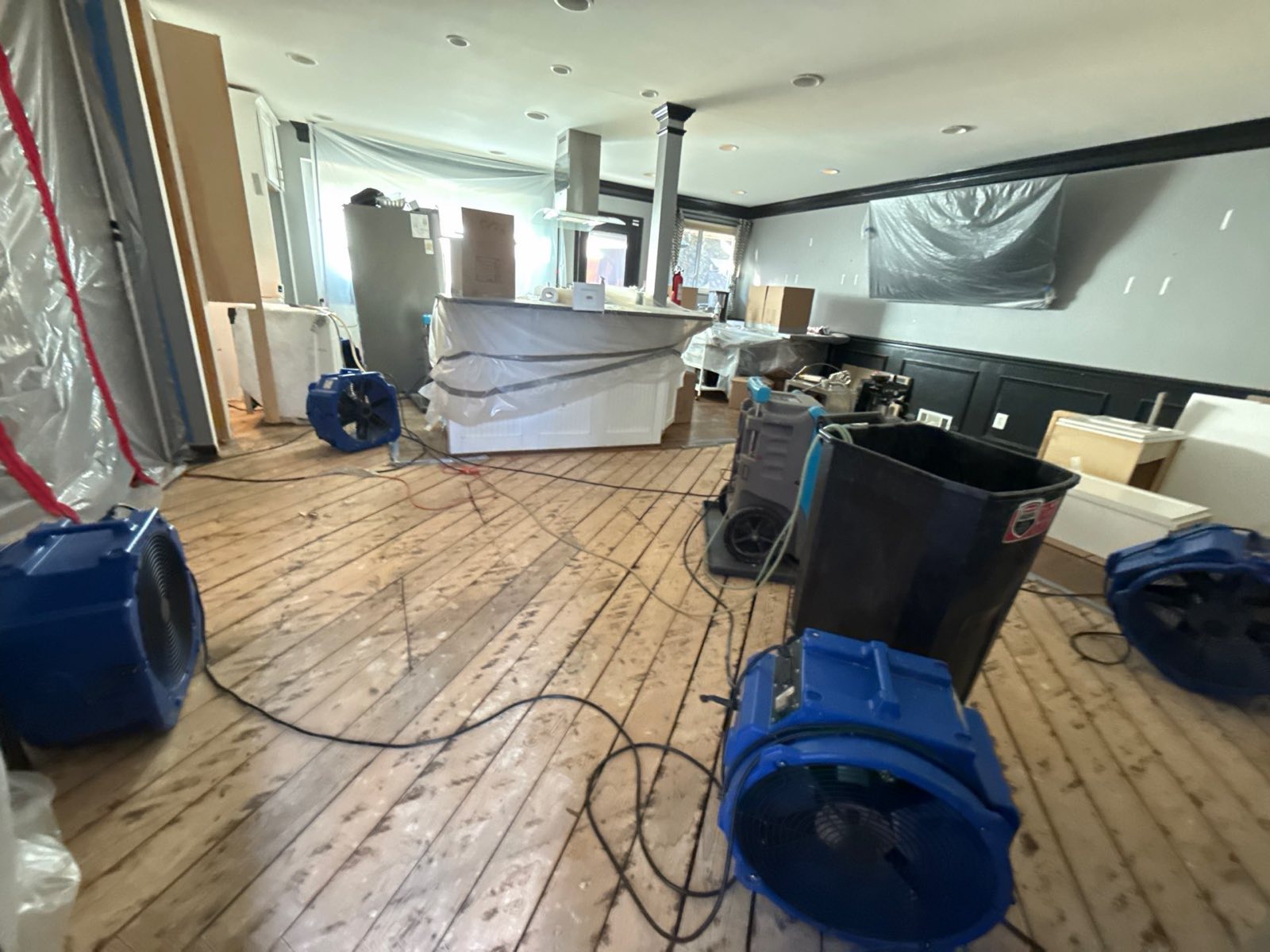
Water Damage Restoration in Staten Island
Staten Island is the borough where New York houses look like houses — detached homes with real basements, real yards, and real exposure to coastal weather. That combination makes water damage restoration Staten Island homeowners need different from the rest of the city: fewer upstairs neighbors, more sump pumps, groundwater, storm surge, and finished basements that double as family rooms and rental units. Restoration Doctor of NYC covers the whole island, 24 hours a day, at (646) 789-6264.
A Staten Island basement flood has more possible causes than almost any loss in the five boroughs: a sump pump that quit during a power outage, a water heater that let go, groundwater rising through the slab after a week of rain, a sewer lateral backing up, or — along the East and South Shores — tidal surge pushing in during a coastal storm. Diagnosing the source correctly matters, because it determines both the drying scope and which insurance coverages might apply.
We extract, dry, and remediate to IICRC standards, handle mold and sewage with proper containment, and document each loss thoroughly — cause, entry point, high-water line, and affected materials — so homeowners have a clean record for whatever policy responds.
The buildings of Staten Island — and how they fail
The island's housing is dominated by detached and semi-detached single-family homes: post-war capes and ranches in Great Kills and New Dorp, colonials and split-levels in Annadale and Eltingville, townhouse developments from the 1970s–90s building boom across the South Shore, and older Victorians and craftsman houses in St. George, Stapleton, and West Brighton near the ferry. Nearly all of them share one feature the rest of the city envies and regrets in equal measure: a full basement.
Those basements are usually finished — rec rooms, home offices, bedrooms, sometimes legal or informal apartments — and they sit on a landscape that was wetlands and streams before it was subdivisions. High water tables across much of the island mean hydrostatic pressure against foundations, chronic seepage at slab cracks and cove joints, and sump pumps running as essential equipment rather than insurance. When a pump fails or a storm outpaces it, the finished basement takes the loss.
The coastal edge adds a category of risk unique in scale for New York: low-lying East Shore neighborhoods — Midland Beach, South Beach, New Dorp Beach, Oakwood Beach — sit in mapped flood zones where storm surge has historically reached homes directly. Houses there increasingly stand elevated on new foundations, but surge, wind-driven rain, and saltwater exposure remain part of any honest risk picture, and saltwater losses require their own protocols for corrosion and material salvage.
How water losses unfold in Staten Island
Sump Failures, Groundwater, and the Finished Basement
The most common Staten Island call is a basement that flooded from below: a sump pump lost power in a storm, a check valve stuck, or sustained rain simply raised the water table past the slab. Groundwater intrusion tends to be cleaner than sewage but still wets carpet, drywall, and framing from the bottom up — and bottom-up wetting wicks into wall cavities higher than the visible waterline.
We cut and dry to what the meters show, not to the stain line. Base molding, lower drywall, and insulation that wicked water typically come out; the framing and slab are dried and verified. We also document the failure cause, because whether a policy responds to sump failure or groundwater varies with the policy and its endorsements — many homeowners discover their coverage details only during the first loss, so our documentation gives them and their insurer clear facts to work from.
Coastal Storms and the East Shore
When a nor'easter or tropical system drives water into Raritan Bay and Lower New York Bay, low-lying East Shore streets flood from the ocean side. Surge water is contaminated — it carries sediment, debris, fuel residues, and salt — and salt is the part people underestimate. Saltwater attacks electrical systems, fasteners, and mechanical equipment even after everything looks dry, so surge losses get a different protocol: fresh-water rinse-down of salvageable surfaces, aggressive removal of saturated porous materials, and careful evaluation of wiring, panels, and HVAC that stood in the water.
Speed matters double on surge losses because coastal events hit whole neighborhoods at once and drying capacity gets scarce. We stage equipment ahead of forecast coastal storms and prioritize occupied homes. Flood-zone claims typically run through flood policies rather than standard homeowners coverage — another area where policies vary — and our cause-and-depth documentation supports that process.
Everything Upstairs: Pipes, Appliances, and Mold
Not every island loss starts in the basement. Frozen pipe bursts in uninsulated crawl spaces and garage ceilings, failed washing machine hoses on second floors, roof and flashing leaks during wind-driven rain, and long-running hidden leaks behind dishwashers all produce classic top-down damage through ceilings and wall cavities. Detached-house construction at least keeps the loss within one family's walls — but it also means the homeowner alone decides, and we make that easy with a clear written scope.
Mold is the follow-on risk in every scenario, and Staten Island's damp basements grow it readily when drying is incomplete. We remediate per IICRC S520 with containment and HEPA filtration, correct the moisture source first, and verify the space is dry before rebuild — because remediation without moisture control is a subscription, not a solution.
Staten Island neighborhoods we serve
Real communities — and the water losses we most often see in each.
Low-lying East Shore flood zone where storm surge and elevated rebuilds define the risk landscape.
Coastal streets facing the bay — surge, wind-driven rain, and saltwater-specific restoration protocols.
Post-war capes and ranches with finished basements riding a high water table.
Detached homes near the harbor where sump failures during outages are the classic loss.
The island's southern tip — older Victorians and newer builds with long private laterals prone to backup.
Hillside Victorians and condo conversions near the ferry, where slope drainage funnels runoff at foundations.
South Shore colonials and townhouses from the building boom, with below-grade family rooms at risk.
Older frame housing stock where aging supply lines and roof leaks drive interior water losses.
Full restoration services in Staten Island
One operation covers every category — from emergency mitigation to full reconstruction.
Water Damage Restoration
Restoration Doctor of NYC provides emergency water extraction, moisture mapping, and structural drying for apartments, co-ops, condos, brownstones, and commercial spaces throughout the five boroughs, working within building rules, insurance documentation requirements, and the realities of vertical living.
Sewage Cleanup
Restoration Doctor of NYC performs emergency sewage extraction, contaminated-material removal, cleaning, and disinfection for sewer backups and drain failures in brownstone cellars, apartment buildings, and commercial spaces throughout New York City.
Mold Remediation
Restoration Doctor of NYC provides containment-based mold remediation for apartments, brownstones, and commercial spaces across the five boroughs, performed in a manner consistent with the IICRC S520 standard and with awareness of New York State and City mold regulations.
Fire Damage Restoration
Restoration Doctor of NYC handles the full arc of fire recovery in New York City properties — emergency board-up and securing, smoke and soot cleaning, odor treatment, water mitigation from firefighting, and structural rebuild — with the building coordination that multi-unit fires demand.
Contents Restoration
Restoration Doctor of NYC provides full contents services for New York City losses: detailed photo inventory, professional pack-out through the realities of NYC building access, specialized cleaning and deodorization, climate-controlled storage outside Manhattan, and coordinated return after rebuild.
Reconstruction
Restoration Doctor of NYC rebuilds water-, fire-, and mold-damaged spaces across the five boroughs, managing the approvals, access logistics, and trade coordination that New York buildings require, and restoring everything from patched drywall to full gut renovations of loss-affected units.
Verify us before you call
Our customer feedback lives on the network's verified reviews hub and on our New York City Google Business Profile — source-linked aggregates, never numbers typed onto a marketing page. Check both, then call.
Frequently asked
Active water, mold, fire, or sewage event?
Connect directly with the Restoration Doctor team for your region. Crews are on standby 24/7 with documented response protocols.
Financing available through Stripe, subject to lender approval.